
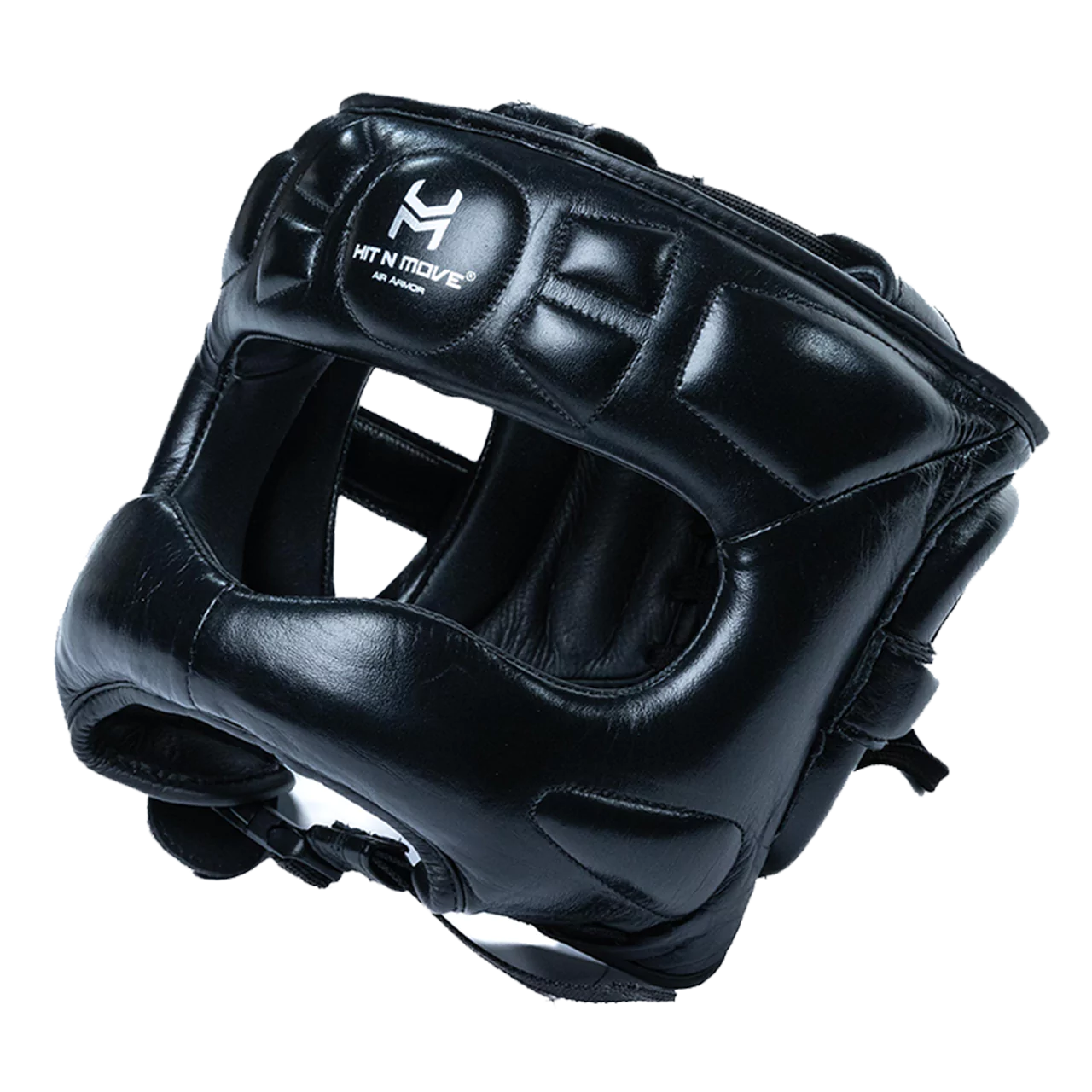

WInd Tunnel Tested Boxing Gloves
Add your custom HTML content for this experiment in the section settings.
NOT TO PROVE.
TO DISCOVER.
For the first time in boxing, HIT N MOVE partnered with the University of Maryland to conduct a series of experiments inside its state-of-the-art wind tunnel, centred around two fundamental questions:
1. Can the aerodynamics of a boxing glove genuinely influence a fighter's performance?
2. Can proper punch alignment be measured from the outside of a boxing glove?
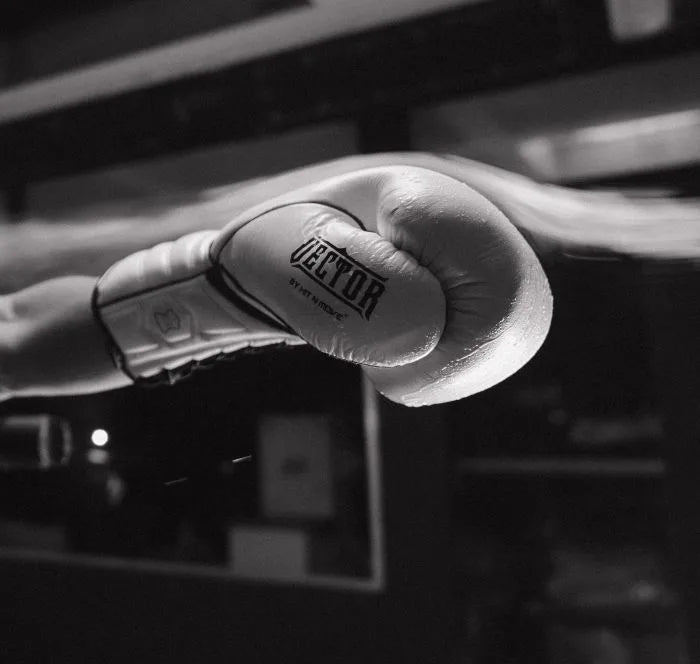
WHAT DOES THE SCIENCE SAY?
CAN AERODYNAMICS AFFECT PERFORMANCE?
Even if the wind tunnel can reveal measurable differences, the harder question is whether those differences are large enough to create a noticeable change in performance. That answer cannot come from the wind tunnel alone. But if there is a measurable advantage, is it worth pursuing?
We believe it is.
Boxing is a game of millimetres, where one split-second decision can lead to a career-defining knockout or a career-ending injury. That is why we are committed to investigating every possible advantage, no matter how small.
Explore the aerodynamic findings in Experiments Two and Three.
PADDING VS. PROTECTION
THE MOST NEGLECTED FACT IN BOXING GLOVES
Alignment is just as important as padding. This is a principle the boxing industry has largely ignored. But with hand injury rates still unacceptably high, we have to confront the limitations of padding alone.
Protection should not stop at cushioning impact. A glove should also align the fist, allowing the hand’s natural structure to distribute force the way the human body was designed to.
Explore the punch-alignment findings in Experiments One and Four.
WHERE SHOULD A BOXING GLOVE LAND FIRST?
Ideally, a punch connects through the index and middle knuckles. This creates a stronger line for transferring force through the hand, wrist, and into the forearm.
But punches aren't always ideal.
Angles change. Fatigue creeps in. Technique slowly fades.
So we wanted to know:
When technique starts to break down, which knuckles does the glove naturally position behind the first point of contact?


How We Tested It
Concentrated airflow was directed toward the punching surface of the glove at 30 mph. The first area to interrupt the airflow revealed the glove's most forward point (the area positioned to make contact first).
We then compared that point with the previously mapped position of the index and middle knuckles inside the glove.
If the glove's first point of contact sits directly over the index and middle knuckles, we can confirm that the exterior punching surface is aligned with the correct knuckles inside.

What We Found
VECTOR™ prototypes consistently made first contact over the index and middle knuckles.
That matters because no fighter is spared from fatigue. A fighter can maintain proper punching alignment when fresh. But as fatigue sets in and technique deteriorates, the glove should naturally favor the strongest possible impact position rather than work against it.
HOW IT SHAPED VECTOR™

We attribute the result to two of our Pro Fist Principles: Square Fist Alignment, which controls the orientation of the fist, and MCP Connect Grip Bar, which helps position the knuckles correctly inside the glove.
Both were developed during our original ergonomic trials using X-ray imaging of the hand inside the glove.
The wind tunnel gave us a way to examine the glove's exterior contact point and knuckle position inside.
The results allowed us to verify the alignment before creating the final VECTOR™ design.
CAN GLOVE AERODYNAMICS AFFECT PUNCHING PERFORMANCE?
We expected differences in how each glove moved through the air.
The real question was whether they would be large enough for a fighter to notice in sparring.

HOW WE TESTED IT
Each glove was exposed to 30 mph airflow, simulating the air moving around a glove during a punch. We studied the wake: the trail of air left behind the glove as airflow moved around it.
- Straighter wake = less aerodynamic disruption
- Larger, turbulent wake = more aerodynamic disruption
In theory:
More disruption = more resistance = more energy required per punch.
Hit n Move VECTOR™

Comparision GLoves

WHAT WE FOUND
VECTOR™ produced a straighter wake than the comparison gloves. The measured differences were approximately:
- 2% better acceleration
- 3% better deceleration
(Faster acceleration & deceleration = less energy used per punch)
These are not differences a fighter would necessarily notice on the first or second punch. But boxing is built on repeated movements, and small differences become more relevant as punch volume rises and fatigue sets in.
The test also revealed something beyond speed: the airflow allowed us to observe how consistently each glove retained its intended shape under the 30 mph airflow. This structural integrity becomes increasingly important as technique fades, because a glove that holds its intended shape can help keep the hand and wrist better supported.
HOW IT SHAPED VECTOR™

We attribute these results to Pro Fist Principle 4: Intelligent Weight Distribution, which strategically distributes mass throughout the glove to improve balance and help maintain its orientation and structure through movement.
The test gave us measurable feedback on VECTOR™'s balance, aerodynamic behaviour, and structural stability, helping us preserve those characteristics through the final design.
We did not leave the wind tunnel claiming to have the most aerodynamic glove.
Instead, we found small, measurable differences. And in a sport decided by fine margins, we believe measurable advantages should not be dismissed.
HOW DOES A GLOVE’S BUILD AFFECT ITS AERODYNAMICS?
We believe airflow is influenced by the outer material, the padding beneath it, and how consistently the striking surface holds its shape.
So by studying the airflow around each glove, we could see how those construction differences affected airflow across the striking surface.

HOW WE TESTED IT
The University of Maryland's Wind Trace test mapped airflow across the outer surface of each glove, creating a visible pattern of how the air travelled across it.
- An even, rail-like ridge = more consistent airflow across the striking area
- A pronounced V-shaped pattern = greater airflow variation across the striking area
More variation in the wind trace = more disrupted airflow = more energy wasted per punch.

WHAT WE FOUND
VECTOR™ produced a consistent, rail-like wind trace.
We attribute VECTOR™'s pattern to three things:
- Even padding density across the striking surface
- The natural texture of cowhide leather
- The laminated leather’s resistance to deformation
The test also showed that our genuine Turkish cowhide allowed air to move smoothly across its natural surface.
HOW IT SHAPED VECTOR™

The results supported two parts of VECTOR™ already under development:
1. Consistent padding density developed for the new 6-layer construction
2. Laminated genuine cowhide, combining its natural surface characteristics with added structural stability
The wind trace gave us a new way to verify that both were working together to create a consistent striking surface and smoother airflow across it.
WHEN IMPACT TRAVELS THROUGH A BOXING GLOVE, WHERE DOES THE FORCE GO?
For a glove to align with the hand's natural force path, its structure needs to carry force from the hand and wrist into the stronger structural line of the forearm.
So we wanted to measure how well different gloves supported and distributed a controlled load.

HOW WE TESTED IT
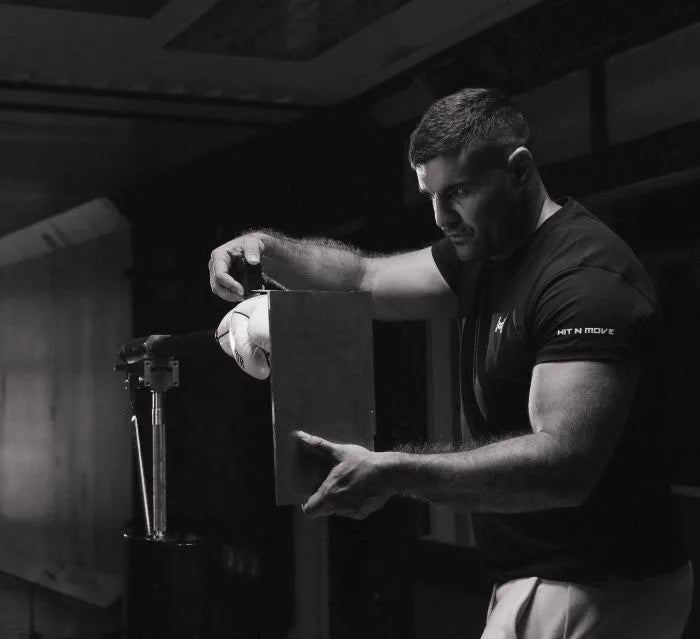
A flat 2lb platform was loaded above and across the glove's striking surface.
This simulated force being applied through a straight punch and allowed us to see how well each glove held its shape under load.
TEST SCOPE
This experiment measured straight-punch alignment. Hook mechanics involve different wrist demands and were outside the scope of this test.

WHAT WE FOUND
VECTOR™ distributed the applied load evenly. Some comparison gloves struggled to support the test platform at all.
That distinction matters because when a glove collapses under load, it reveals a weak point where pressure can concentrate and create vulnerability.
Proper structural support allows the force to travel through the hand's natural path.
HOW IT SHAPED VECTOR™

The test gave us a measurable way to verify the structural support already built into VECTOR™.
Those findings helped us refine how the final glove holds its shape and carries force through impact.
The goal was never to eliminate movement.
It was to better align where force travels.
STATE OF THE ART
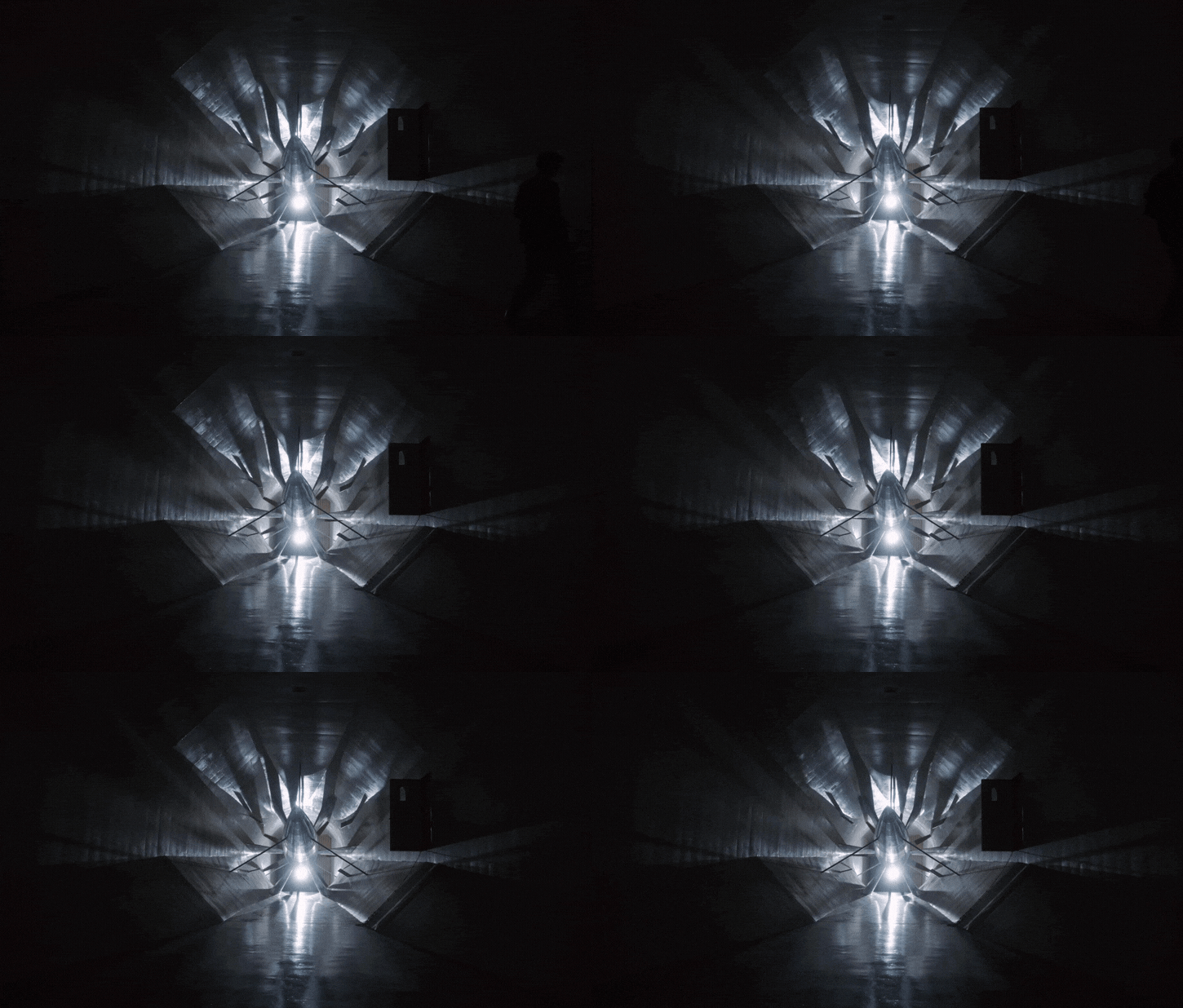
MARYLAND UNIVERSITY WIND TUNNEL
One of the most prestigious aerodynamic facilities in the world, with over 75 years of experience, the tunnel has completed more than 2,200 tests for over 300 clients, including Boeing, Lockheed Martin, Ford, and the United States military.
That same standard of precision and performance has now been directed towards one purpose: how can we build a better glove for fighters?

THE PURSUIT OF 1%
INNOVATION RARELY HAPPENS ALL AT ONCE.
Boxing gloves have been shaped for generations by craftsmanship, experience, and fighter feedback. We believe the next step is not to replace those foundations, but to strengthen them with modern science and research.
Sometimes an experiment will confirm what we believed; other times it will prove us wrong. Both move us forward. Because if there is even a 1% improvement left to find, we believe it is worth looking for.
And we intend to find it.