
Boxing gloves have been around for decades, and yet when we searched to see what research was being done, there was nothing. As the world moved into the modern era, other high-impact sports like football, rugby, racing, and more were all investing big money into performance and protection, but not boxing. Why?
Instead, boxers were left with generic claims like “maximum protection” and “great wrist support”, followed by a paid promotion promising that certain fighters liked the gloves.
Boxers deserve better, which is why we invented Pro Fist Principles. These are the principles that every glove must have in order to claim maximum protection and performance. These are not based purely on our beliefs and are developed through meticulous testing, consulting with performance and scientific experts, and then verified through experiments such as X-ray and wind tunnel testing.
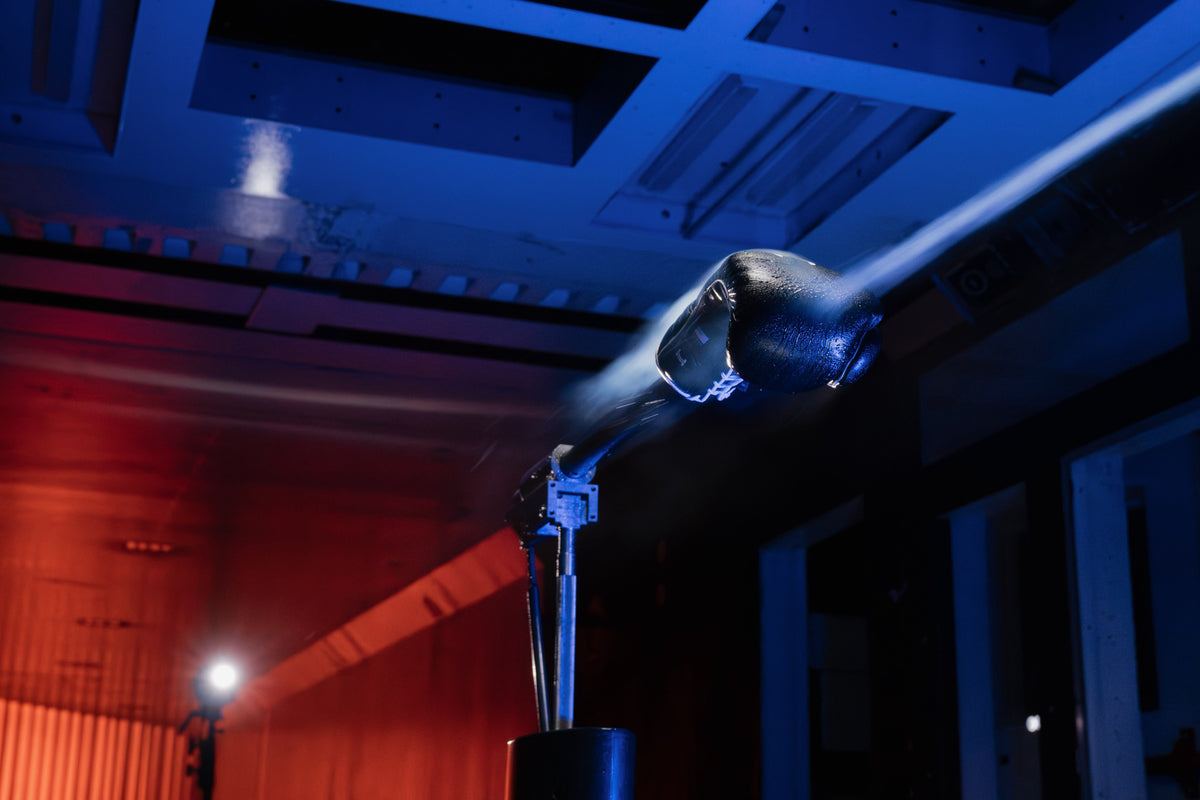
Wind tunnel, in particular, was used for the first time when developing Vector at the Maryland University Wind Tunnel. One of the most prestigious aerodynamic facilities in the world, with over 75 years of experience, the tunnel has completed more than 2,200 tests for over 300 clients, including Boeing, Lockheed Martin, Ford, and the United States military.
Through this testing, we verified and altered principles 3 and 5 for improved protection using the natural alignment of the hand.
1. Perfect Fist Shape: Square Impact Zone

What Is Wrong With Current Gloves?
Faulty design causes the wrong posture and increases the risk of injury.
Other gloves result in punching with the interphalangeal (IP) joints of the hand, which are the hinge joints between the phalanges (finger bones).
How It Should Be And Why?
A correct punch must be delivered by the MCP joints, or the metacarpophalangeal joints, which are the knuckles of the hand, where the bones of the fingers (phalanges) connect to the hand bones (metacarpals).
2. Radius Lock™: Anatomical Precise Positioning

Radius Bone Alignment
The gloves should be shaped to support the wrist by aligning the index and middle MCP(knuckles) with the radius bone of your arm, placing your wrist in a strong, natural position during impact and ensuring the index and middle finger MCP (knuckles) are the first contact.
Reinforced Support For Wrist
This should reduce strain, prevent injuries, and ensure your wrist remains stable through every punch, boosting both safety and endurance.
3. Padding: Layers, Thickness, and Construction

Layered Structure
The layered padding should be designed to soften over time with use, enhancing comfort, while maintaining its structural integrity without collapsing or losing shape.
Robust Horse Hair Construction
If horse hair is used, only true horse hair patches must be employed; no shredded wool or external materials should be included. The padding should consist solely of long, intact horse hair within a pouch.
4. Intelligent Weight Distribution: The Dr-T Standard (Founded in 2022)

Balanced Weight Distribution
Inspired by Dart weight distribution, our proprietary DR-T ratios ensure the glove’s weight is perfectly balanced and confirm that punches fly like an arrow and hit with maximum force, without being top-heavy or wrist-heavy.
Tested In Wind Tunnel
Tested in the Maryland University Wind Tunnel. One of the most prestigious aerodynamic facilities in the world, with over 75 years of experience, the tunnel has completed more than 2,200 tests for over 300 clients, including Boeing, Lockheed Martin, Ford, and the United States military.
That same standard of precision and performance has now been directed towards one purpose: how can we build a better glove for fighters?
5. MCP Connect™ (Proprietary Curved Grip Bar)

The Unique Curved Grip Bar
We meticulously studied the deep transverse metacarpal ligament and its connection to the knuckles, ensuring the glove’s grip bar aligns perfectly with the natural shape of the hand.
Inspired By Human Hand Anatomy
The shape, position, and angle of the grip bar are designed so that when an athlete makes a fist, the knuckles are correctly aligned, minimizing and maximizing power. Leveraging detailed anatomical research, our grip bar supports a natural fist formation, reducing strain and enhancing punch efficiency.